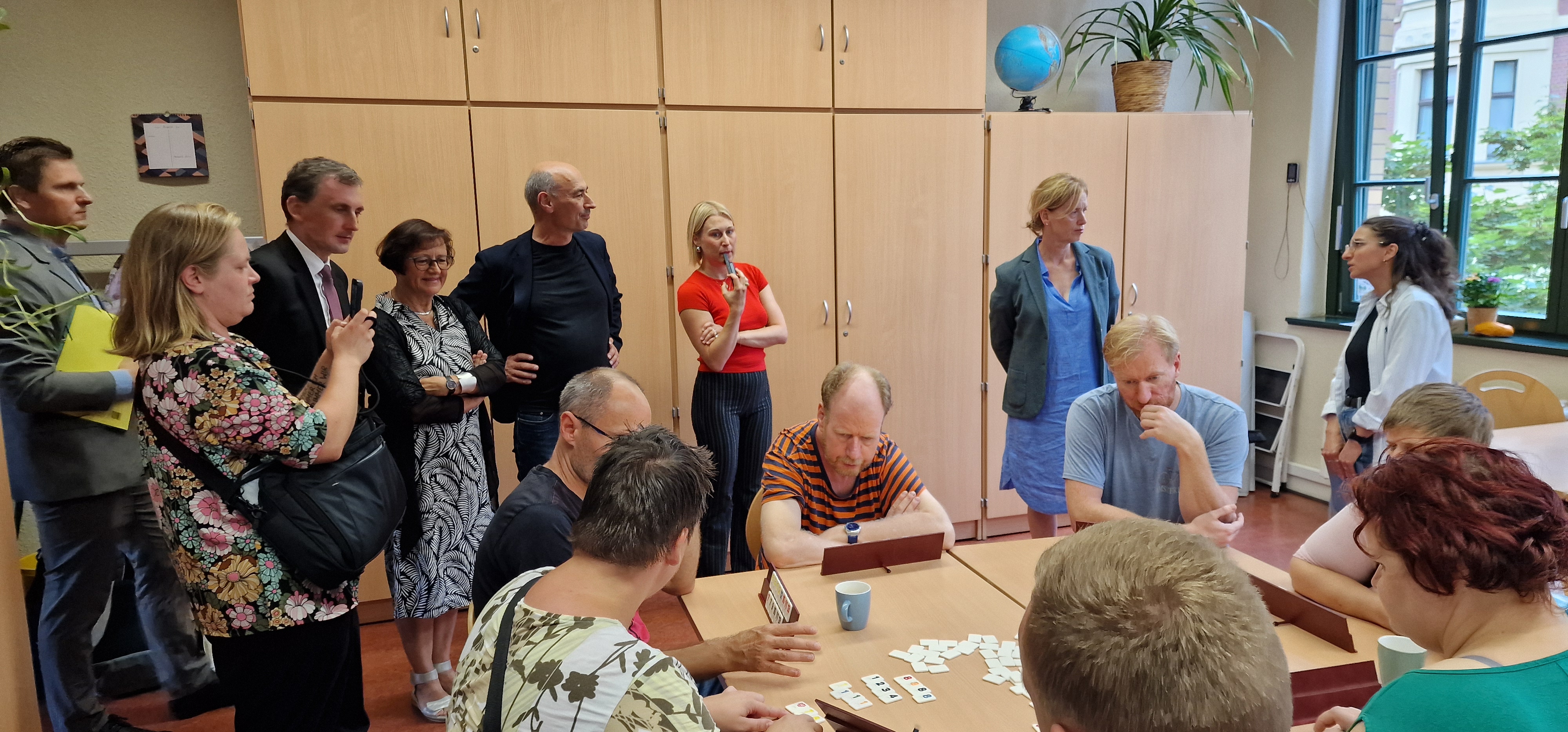
What does it take to be truly independent in everyday life today? Reading and writing are essential, but so are smartphones, digital applications, and, increasingly, artificial intelligence. During a visit by Federal Minister of Education Karin Prien and Saxony-Anhalt’s Minister of Education Jan Riedel to the Magdeburg Municipal Adult Education Center, it became clear that basic education is evolving—and becoming more important than ever.
On August 28, Federal Minister of Education Karin Prien and Saxony-Anhalt’s Minister of Education Jan Riedel visited the Magdeburg Municipal Adult Education Center and its affiliated Basic Education Center. The focus was on literacy and basic education, digital skills, and the question of how adult education can reach people in a rapidly changing world.
"Adult education centers are vital hubs: they enable people, regardless of their background, to pursue flexible lifelong learning and develop the skills they need for daily life and the job market," emphasized Karin Prien. "Basic education opens the door to shaping one's own future and unlocking personal potential."
Basic education is more than just reading and writing
The tour and subsequent discussion highlighted what basic education means today. To manage everyday life independently, people now need far more than just traditional reading, writing, and arithmetic skills.
Filling out an online form, using an app, evaluating information on the web, or navigating the digital services of government agencies and companies: for many, these seemingly routine tasks are a significant hurdle.
During the visit, Saxony-Anhalt’s Minister of Education Jan Riedel also underscored the social dimension of the topic: "Basic education is a matter of educational equity and social participation."
At the Magdeburg Adult Education Center, basic education is therefore intentionally defined in broad terms. In addition to reading and writing, this includes digital, health, and financial literacy. The goal is not learning for learning's sake, but rather the practical ability to better manage daily life and act with greater self-determination.
One example of this is the project "Fit for the Digital World". Here, people can receive support if they are having trouble with their smartphone or laptop. This also creates a low-threshold entry point to other learning opportunities, as it is often easier to say, "I'm struggling with my smartphone," than to admit to difficulties with reading or writing.
And suddenly, AI is part of basic education too
Artificial intelligence was a key topic of discussion during the visit. Karin Prien emphasized that people must continue to acquire new digital skills long after their formal schooling ends. The challenge lies in identifying who needs additional support in digital development and finding ways to reach those individuals.
Especially when it comes to AI, low-threshold access is essential. People should be able to understand what AI can do, where its limitations lie, and how to use the technology competently and critically.
Prien saw such a low-threshold approach in the exhibition "Hello AI – who should I vote for in Saxony-Anhalt?", which uses AI-generated images to visualize political content. During the discussion, she described this combination of civic education and AI literacy as a successful way to introduce people to the topic and promote a critical approach to AI.
This gives lifelong learning a new meaning: education does not end with a school diploma or vocational training. New technologies are changing our daily lives and the working world so rapidly that continuous learning is becoming a necessity.
Don't wait for people to come to education
Another takeaway from the visit: good programs alone are not enough. The key is actually reaching people.
For adults with negative school experiences in particular, a traditional school building can be a barrier in itself. That is why the Basic Education Center works with various partners and focuses on reaching people directly in their own environments—for example, through employers, social institutions, or local community programs.
Such networks take time. Trust is not built overnight. This makes it all the more important to maintain established structures and points of contact over the long term.
Adult education centers remain a place for connection
Digital or in-person? The experience of the past few years has provided a clear answer for the vhs Magdeburg: both—but with purpose.
Online offerings make courses possible that might not otherwise run locally due to low enrollment. Digital self-study options can also be useful for acquiring professional skills on short notice.
At the same time, the post-pandemic period has shown how important personal contact is. People don't just attend an adult education center for the course material alone. They want to meet others, exchange ideas, and learn together.
In the digital age, the vhs remains a place for connection.
What about the freelance instructors?
Another topic currently on the minds of many adult education centers was also discussed: the future legal framework for freelance teachers and contract instructors.
They are indispensable to adult education centers. They allow for flexible responses to new topics and immediate educational needs. At the same time, institutions need planning security—especially for long-term programs like integration courses.
During the discussion, Karin Prien confirmed that a solution is being worked on at the federal level. She emphasized that there must be practical regulations for those who are employed full-time elsewhere and work as instructors on the side. This group must not be disadvantaged by any new regulations.
Tailwind for basic education
The visit also provided an important signal for the work of the basic education centers. The current decade for literacy and basic education ends in 2026. In the discussion, Prien made it clear that the joint efforts of the federal and state governments in the field of literacy and basic education will continue. Details were still being coordinated at the time of the visit.
This outlook is crucial for practical work. Successful basic education relies on more than just individual courses. It requires people, networks, trust—and structures that endure over the long term.
The visit to Magdeburg showed one thing above all: Basic education is not a thing of the past. It evolves with our society. Today, it ranges from reading and writing to digital skills and artificial intelligence—and it is a fundamental factor in determining who can participate in social and professional life with self-determination.
Lifelong learning applies to us, too: That is why we use artificial intelligence as a tool when creating text and images. However, all content is selected, reviewed, and managed by our team members.