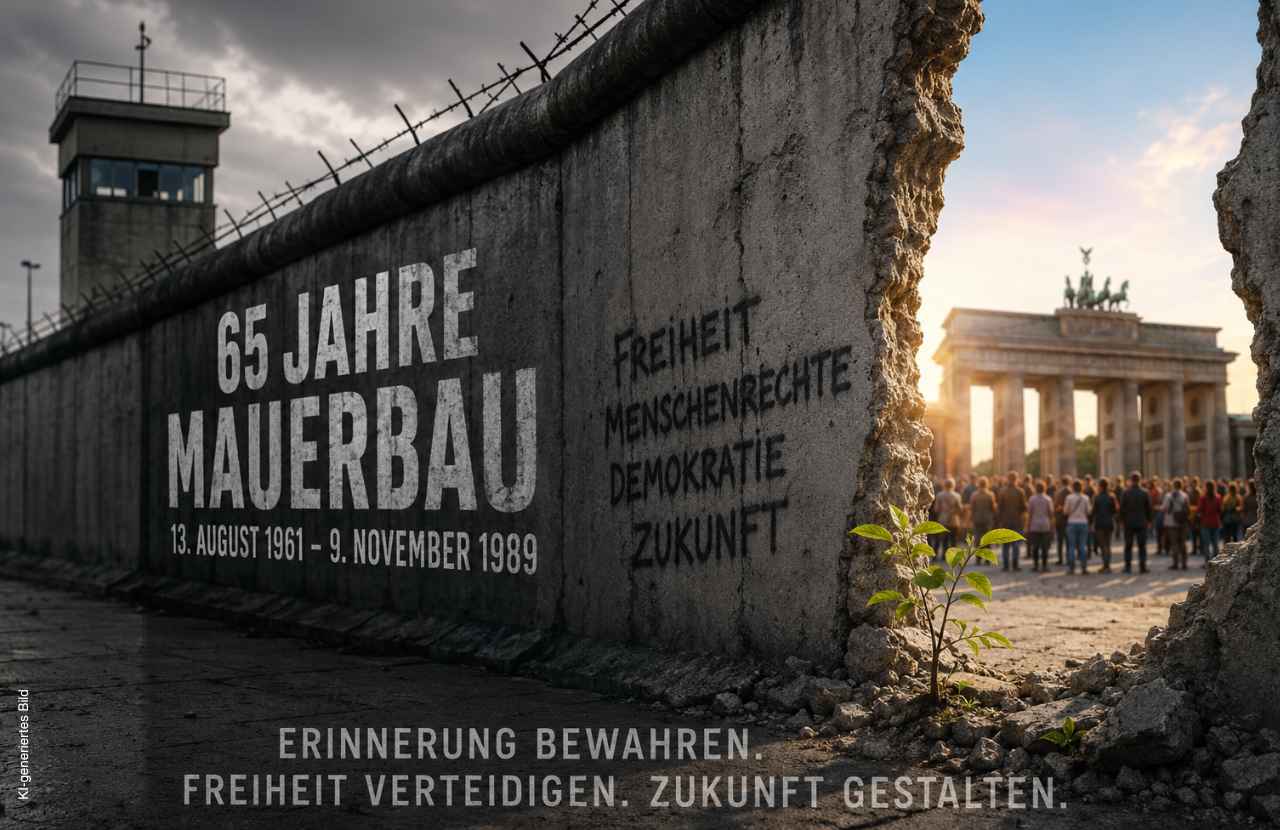
On August 13, 1961, construction of the Berlin Wall began. A border was drawn right through the heart of a vibrant city, separating families, friendships, and lives overnight. The Wall became the visible symbol of Germany's division and the lack of freedom in the GDR. It did not fall until November 9, 1989—more than 28 years later.
To this day, the construction of the Wall serves as a reminder of the value of freedom, human rights, and democratic participation. Many people lost their lives attempting to flee, while others were arrested or forced to live for years separated from their loved ones. The exact number of fatalities at the Berlin Wall varies depending on the counting method; the Federal Government cites more than 140 deaths in connection with escape attempts.
Education requires freedom
One of the most important lessons from this era concerns education. Education should empower people to think for themselves, ask questions, explore different perspectives, and form their own opinions. It must not be used to instill a worldview dictated by the state or political interests.
The history of the GDR, in particular, shows the consequences of politically co-opting education and social institutions. When young people no longer learn to critically examine information, weigh arguments, and question existing beliefs, their capacity for independent opinion-forming is weakened.
This does not mean that schools must be neutral regarding the fundamental principles of a democratic society. Human dignity, freedom, the rule of law, and the equality of all people are the core foundations of our coexistence. What is crucial, however, is that students learn why these values are important—rather than simply being told which opinions they should hold.
Democracy cannot be taken for granted
The 65th anniversary of the construction of the Wall is therefore more than just a historical date. It is a reminder that freedom and democracy are not guaranteed. They must be understood, practiced, and protected by every generation. On the 60th anniversary, Federal President Frank-Walter Steinmeier also emphasized that freedom and democracy are not achieved once and for all, but must be continuously protected and maintained.
Reintroducing education based on a prescribed political opinion—regardless of its source—would therefore be a concerning step. Where instruction no longer fosters independent judgment but instead presents specific political viewpoints as the only valid ones, there is a risk that critical thinking will be replaced by conformity.
Democratic education must therefore achieve one primary goal: it must empower people to think for themselves.
Anyone who takes the history of Germany's division seriously should remember this. The Wall stood for more than just a border of concrete and barbed wire. It also stood for the limitation of freedom. Its overcoming was therefore not just the end of a structure, but a victory over oppression.
65 years after the Wall was built, the task remains to keep this memory alive—not as a political mandate, but as an invitation to reflect. For a free society needs people who know their history, can tolerate differing opinions, and have the courage to judge for themselves.
Lifelong learning applies to us, too: That is why we use artificial intelligence as a tool in the creation of our texts and images. However, all content is selected, reviewed, and held accountable by our staff.
